Target audience
Industrial companies with no or insufficient reporting
Challenge
Are you — like 60 percent of production managers — dissatisfied with your KPIs?
Manual data collection is still often time-consuming, which is why it is limited to a minimum → poor data basis
Calculation and publication of many KPIs happens in far too long intervals (e.g. monthly)
KPIs often contradict each other?
Existing KPIs do not reflect the actual potentials (downtime and loss analysis, weak points, bottlenecks)
KPIs are calculated but come with no responsibilities and no actions
How it works
4MGT supports end-to-end performance management from single-piece to small-series production. With appropriate KPIs, reports and cockpits, 4MGT helps you
• to uncover individual potentials,
• to ensure a continuous improvement process and continuous improvement,
• to secure the level achieved, detect undesirable developments early and
• to implement corporate strategies at every level.
4MGT is a modular toolkit that combines individual KPIs, cockpits and workflows and enables an effective management cockpit.

The economic potentials of production can be expressed in the three dimensions of quality, cost and time (the "magic triangle"). There is a wealth of KPIs that can be assigned to these dimensions. The Association of German Machinery and Plant Manufacturers (VDMA) has defined the KPIs for manufacturing companies in its guideline 66412.
1. Machine/workstation:
- Utilisation rate
- Throughput
- Effective utilisation rate
- Availability rate
- OEE/GAE/NEE index
- Availability
- Effectiveness
- Setup rate
- Technical utilisation rate
- Process rate
2. Workforce:
- Employee productivity
3. Quality:
- Quality rate
- Scrap rate
- First Pass Yield (FPY)
- Reject quota
- Rework quota
- Fall off rate
- Machine capability index (Cm)
- Critical machine capability index (Cmk)
- Process capability index (Cp)
- Critical process capability index (Cpk)
The objective of performance management is the systematic measurement and control of performance for different application objects or levels (employees, teams, departments, processes) with the goal of raising both individual and corporate performance.

A common problem here is that companies show considerable deficits precisely when it comes to performance management. Financial KPIs dominate, non-financial KPIs are useless because managers do not check whether these KPIs are really the performance drivers of the company. McKinsey shows that eight out of ten top managers are dissatisfied with their current management KPIs and that half of them do not use self-developed performance indicators. 60 percent of production managers are dissatisfied with the KPIs provided to them. Half of the managers have no KPI system at all, so that the PDCA cycle of planning, doing, checking and acting is not closed. The reasons for this are diverse but include, among others:
- manual data collection is still often time-consuming and therefore limited to a minimum (consequence: poor data quality and estimated times)
- the calculation and publication of many KPIs happens in far too long intervals
- frequently available KPIs, such as machine and plant utilisation, contradict each other (e.g. utilisation vs. on-time delivery and lead time)
- existing KPIs do not reflect the actual potentials of production (downtime and loss analysis, weak points, bottlenecks)
- KPIs are calculated but no responsibilities and actions are linked to them
→ 4MGT supports the build-up of an end-to-end performance management system
Functions
- Provision of raw data or individually calculated values as a file, SQL database or via OPC-UA & REST API for BI/data warehouse systems
- Visualisation of any data as printable reports using, among others, iReport
Example references
Brochure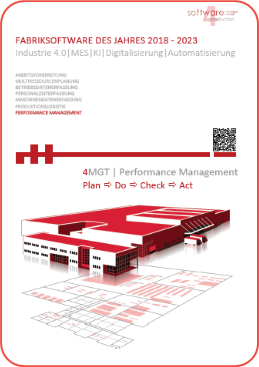
Benefits
- Competitiveness ↑
- Transparency ↑
- Responsibility ↑
- Real-time information ↑
- Costs ↓
- Process know-how
- Consulting know-how
- Partner and technology network
- Highest flexibility and customisability